
Archive for the ‘Infinity Award’ Category

Celebrating Roger Zelazny, SFWA’s Newest Infinity Award Recipient
FOR IMMEDIATE RELEASE
Celebrating Roger Zelazny, SFWA’s Infinity Award Recipient for the 61st Annual Nebula Awards

San Francisco, CA – April 15, 2026

The Science Fiction and Fantasy Writers Association (SFWA) is pleased to announce that the SFWA Infinity Award will be presented this year to Roger Zelazny at the 61st Annual SFWA Nebula Awards® ceremony on June 6, 2026.

The SFWA Infinity Award was created to highlight the life and work of creators who achieved a distinct and tremendous legacy in science fiction and fantasy. Although they are no longer with us to celebrate this honor, these writers helped to lay the foundation for today’s science fiction, fantasy, and related genres. Their memory abides not only in the works they published, but also in the worlds they inspired fellow and future writers to dream up in their wake.

SFWA President Kate Ristau reflects fondly on the power of Zelazny’s worlds:

“One of my first deep dives into science fiction was The Chronicles of Amber. Zelazny drew me right into the story with his world-building and world-breaking. Characters could manipulate their reality, walking between worlds, and they didn’t always make the decisions you wanted. There were heartbreaking moments and series-wide challenges that were epic and unforgettable; they lingered with you. Zelazny’s impact lingers on with us, shaping how we think about multiverses and how we create characters that are complicated, nuanced, and sometimes deeply flawed. I am honored to present him with this year’s Infinity Award.”

Challenges of the Multiverse

Roger Zelazny entered our genre’s publishing record in 1962, the same year as Samuel R. Delany and Ursula K. Le Guin, and the era of his ascension as a writer was marked by heated debates about the nature of science fiction and fantasy. Some called the work that he and his peers published “New Wave”, a term bound up in contemporaneous social criticism about the uptick in experimental and more “worldly” art, film, literature, and music.

This catch-all term was used in a positive light by some, to suggest a transformation in the genre: a coming-of-age for SFF as a thoroughly “literary” form, featuring more comfortable and slipstream uses of science-fictional and fantastical tropes to tell more nuanced human stories. It was also used in a negative light by some critics, to cast aspersions on SFF writers who played too poetically with language, “wrote back” against ancient myths and story structures, and wrestled with recent insights from psychology and sociology in their prose.

As for the writers themselves, including Zelazny?

Most were less interested in the labels used by critics to describe their work, and more in how to keep growing their craft – often in publishing contexts we can also learn a great deal from today.

Zelazny developed as a writer in an era when magazines were common incubators for novel-length masters of the craft. Widely read by paying customers, the major magazines of Zelazny’s day had different opportunities to curate budding and distinct voices like his.

After winning Nebula Awards for both novelette and novella (published in Amazing and F&SF) at the very first Nebulas for 1965, Zelazny w0n a Hugo for Best Novel with what was first a serial production, delighting readers over two issues of F&SF in 1965. Zelazny’s This Immortal (first printed as “…And Call Me Conrad”) would tie for that Hugo with another patchwork publication by another SFWA Infinity Award recipient: Frank Herbert’s famed fix-up novel, Dune, which received the Nebula for that year.).

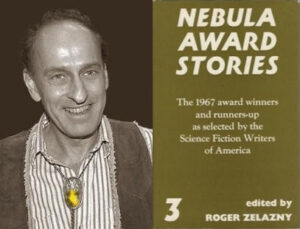
Zelazny’s Lord of Light (1967), nominated for a 1968 Nebula and winning the Hugo, would then entrench his distinct voice and approach to mythic world-building as a key component of mid-century SFF canon. That year, he would also support SFWA’s internal curation of canon, by editing our third-ever Nebula Award Stories anthology and providing thoughtful remarks on each tale.
 

Our 2025 SFWA Infinity Award Recipient: Frank Herbert

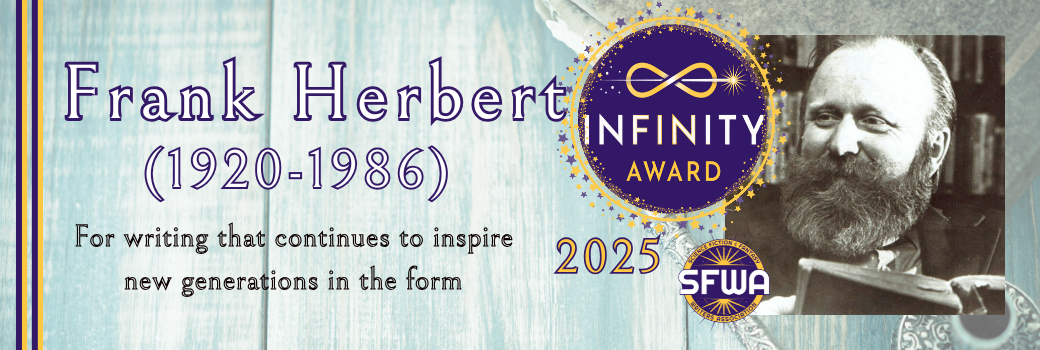
Banner for Frank Herbert, this year's Infinity Award recipient.

In 1965, two pretty great things happened in science fiction: Damon Knight founded SFWA, and one of its earliest members published a book that would become a classic that continues to inspire.

It’s no wonder, then, that as the Science Fiction and Fantasy Writers Association marks 60 years as an organization committed to the uplift and defense of writers in the genre, we would turn our sights to some of the people who worked and dreamed with us from the start.

SFWA is honored to name Frank Herbert, acclaimed author of the Dune series, among other thought-provoking works of science fiction with sweeping ecological, economic, and sociopolitical depth, as our 2025 recipient of the SFWA Infinity Award.

Now in its third year, the SFWA Infinity Award serves to highlight the achievements of creators who did not live long enough to be considered for the Damon Knight Memorial Grand Master Award, but who achieved a distinct and tremendous legacy in science fiction and fantasy.

Frank Herbert first published in the genre in 1952, with a story called “Looking for Something” in Startling Stories. He carved out clear thematic territory with a serial tale in Astounding that grew into The Dragon in the Sea (Doubleday, 1956): a book informed by global strife and oil anxieties.

Herbert’s most famous work was similarly inspired by the world around him: an idea just too big to contain in a single article about the Oregon dunes.

Despite a few early run-ins with rejection, and with a little help from a publisher better known for auto-repair manuals, Dune (1965) grew in acclaim to become the much-beloved SFF franchise that exists today.

Dune was SFWA’s first Nebula winner for Best Novel, chosen over 11 other finalists, and it won joint honors for the Hugo, too. But on the financial front, Dune was not an immediate commercial success. Instead, it initially boosted Herbert in work closely aligned with the ecological, sociopolitical, and philosophical themes that his writing advanced. Posthumously, his series would be continued by his son, Brian Herbert, and Kevin J. Anderson, working off the extensive notes Frank Herbert left about his SF universe.

In life, though, Herbert’s writing was always responding to our own.

As SWFA President Kate Ristau reflects on this year’s Infinity recipient:

“Frank Herbert was a master of the craft whose most famous work emerged from close attention to the environment around him. Since 1965, Dune has inspired generation after generation of writers. His most highly acclaimed series, a master class in worldbuilding, drew routinely on real political history during its creation, and it now serves to remind us that science fiction and fantasy are natural mediums for challenging hierarchies and fighting for the greater good. Like the Fremen, we can refuse to accept living in systems broken for most of us by design, and we can become better stewards of the lands we call home.

Herbert launched a conversation that hasn’t stopped since he got started. His legacy can be seen not only in the number of writers who build on his work today with stories tackling ongoing ecological and sociopolitical challenges, but also in the number who write in constructive dissent with aspects of his initial universe. He encouraged us to think about how setting informs character, whether on the distant sands of Arrakis or in ecosystems close to home.

Herbert’s most famous novel is now larger than Shai-Hulud in the imaginations of SFF writers, but it began as but a dream and a struggle, pursued by a writer responding to the challenges in his time.

Now it’s our turn to honor and celebrate Herbert’s powerful work, by carrying forward the best of his ambition into the stories we tell to confront the challenges in our own.”

Speaking on behalf of his family, Brian Herbert writes: “I’m sure my parents, Frank and Beverly Herbert, would have been thrilled that the prestigious Infinity Award is being granted to Frank Herbert, the legendary author of DUNE. While Frank Herbert authored numerous novels, including his magnum opus, it’s important to note that my mother was also a professional writer, and she was with him every step of the way during their 37 years of marriage, providing him with expert advice on everything he wrote. This is her award as much as it is my father’s. I’m very sorry that I cannot attend the convention, but want to personally thank the officers and members of SFWA, as well as the millions of Frank Herbert fans all over the world, for this great award.”

The SFWA Infinity Award will be presented at this year’s Nebula Awards Conference in Kansas City, Missouri, where a 2024 film inspired by Herbert’s writing is on this year’s ballot: a reminder of the many generations of writers who have been moved by Herbert’s words.

We hope to see you out in Kansas City: in celebration of Frank Herbert, our latest Nebula finalists and other very special guests, and 60 years of SFF excellence in the best of creative community.