
Celebrating Roger Zelazny, SFWA’s Newest Infinity Award Recipient
FOR IMMEDIATE RELEASE
Celebrating Roger Zelazny, SFWA’s Infinity Award Recipient for the 61st Annual Nebula Awards
San Francisco, CA – April 15, 2026
The Science Fiction and Fantasy Writers Association (SFWA) is pleased to announce that the SFWA Infinity Award will be presented this year to Roger Zelazny at the 61st Annual SFWA Nebula Awards® ceremony on June 6, 2026.
The SFWA Infinity Award was created to highlight the life and work of creators who achieved a distinct and tremendous legacy in science fiction and fantasy. Although they are no longer with us to celebrate this honor, these writers helped to lay the foundation for today’s science fiction, fantasy, and related genres. Their memory abides not only in the works they published, but also in the worlds they inspired fellow and future writers to dream up in their wake.
SFWA President Kate Ristau reflects fondly on the power of Zelazny’s worlds:
“One of my first deep dives into science fiction was The Chronicles of Amber. Zelazny drew me right into the story with his world-building and world-breaking. Characters could manipulate their reality, walking between worlds, and they didn’t always make the decisions you wanted. There were heartbreaking moments and series-wide challenges that were epic and unforgettable; they lingered with you. Zelazny’s impact lingers on with us, shaping how we think about multiverses and how we create characters that are complicated, nuanced, and sometimes deeply flawed. I am honored to present him with this year’s Infinity Award.”
Challenges of the Multiverse
Roger Zelazny entered our genre’s publishing record in 1962, the same year as Samuel R. Delany and Ursula K. Le Guin, and the era of his ascension as a writer was marked by heated debates about the nature of science fiction and fantasy. Some called the work that he and his peers published “New Wave”, a term bound up in contemporaneous social criticism about the uptick in experimental and more “worldly” art, film, literature, and music.
This catch-all term was used in a positive light by some, to suggest a transformation in the genre: a coming-of-age for SFF as a thoroughly “literary” form, featuring more comfortable and slipstream uses of science-fictional and fantastical tropes to tell more nuanced human stories. It was also used in a negative light by some critics, to cast aspersions on SFF writers who played too poetically with language, “wrote back” against ancient myths and story structures, and wrestled with recent insights from psychology and sociology in their prose.
As for the writers themselves, including Zelazny?
Most were less interested in the labels used by critics to describe their work, and more in how to keep growing their craft – often in publishing contexts we can also learn a great deal from today.
Zelazny developed as a writer in an era when magazines were common incubators for novel-length masters of the craft. Widely read by paying customers, the major magazines of Zelazny’s day had different opportunities to curate budding and distinct voices like his.
After winning Nebula Awards for both novelette and novella (published in Amazing and F&SF) at the very first Nebulas for 1965, Zelazny w0n a Hugo for Best Novel with what was first a serial production, delighting readers over two issues of F&SF in 1965. Zelazny’s This Immortal (first printed as “…And Call Me Conrad”) would tie for that Hugo with another patchwork publication by another SFWA Infinity Award recipient: Frank Herbert’s famed fix-up novel, Dune, which received the Nebula for that year.).
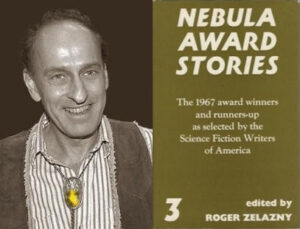
Zelazny’s Lord of Light (1967), nominated for a 1968 Nebula and winning the Hugo, would then entrench his distinct voice and approach to mythic world-building as a key component of mid-century SFF canon. That year, he would also support SFWA’s internal curation of canon, by editing our third-ever Nebula Award Stories anthology and providing thoughtful remarks on each tale.