Author Archive

Celebrating Roger Zelazny, SFWA’s Newest Infinity Award Recipient

FOR IMMEDIATE RELEASE
Celebrating Roger Zelazny, SFWA’s Infinity Award Recipient for the 61st Annual Nebula Awards

San Francisco, CA – April 15, 2026

The Science Fiction and Fantasy Writers Association (SFWA) is pleased to announce that the SFWA Infinity Award will be presented this year to Roger Zelazny at the 61st Annual SFWA Nebula Awards® ceremony on June 6, 2026.

The SFWA Infinity Award was created to highlight the life and work of creators who achieved a distinct and tremendous legacy in science fiction and fantasy. Although they are no longer with us to celebrate this honor, these writers helped to lay the foundation for today’s science fiction, fantasy, and related genres. Their memory abides not only in the works they published, but also in the worlds they inspired fellow and future writers to dream up in their wake.

SFWA President Kate Ristau reflects fondly on the power of Zelazny’s worlds:

“One of my first deep dives into science fiction was The Chronicles of Amber. Zelazny drew me right into the story with his world-building and world-breaking. Characters could manipulate their reality, walking between worlds, and they didn’t always make the decisions you wanted. There were heartbreaking moments and series-wide challenges that were epic and unforgettable; they lingered with you. Zelazny’s impact lingers on with us, shaping how we think about multiverses and how we create characters that are complicated, nuanced, and sometimes deeply flawed. I am honored to present him with this year’s Infinity Award.”

Challenges of the Multiverse

Roger Zelazny entered our genre’s publishing record in 1962, the same year as Samuel R. Delany and Ursula K. Le Guin, and the era of his ascension as a writer was marked by heated debates about the nature of science fiction and fantasy. Some called the work that he and his peers published “New Wave”, a term bound up in contemporaneous social criticism about the uptick in experimental and more “worldly” art, film, literature, and music.

This catch-all term was used in a positive light by some, to suggest a transformation in the genre: a coming-of-age for SFF as a thoroughly “literary” form, featuring more comfortable and slipstream uses of science-fictional and fantastical tropes to tell more nuanced human stories. It was also used in a negative light by some critics, to cast aspersions on SFF writers who played too poetically with language, “wrote back” against ancient myths and story structures, and wrestled with recent insights from psychology and sociology in their prose.

As for the writers themselves, including Zelazny?

Most were less interested in the labels used by critics to describe their work, and more in how to keep growing their craft – often in publishing contexts we can also learn a great deal from today.

Zelazny developed as a writer in an era when magazines were common incubators for novel-length masters of the craft. Widely read by paying customers, the major magazines of Zelazny’s day had different opportunities to curate budding and distinct voices like his.

After winning Nebula Awards for both novelette and novella (published in Amazing and F&SF) at the very first Nebulas for 1965, Zelazny w0n a Hugo for Best Novel with what was first a serial production, delighting readers over two issues of F&SF in 1965. Zelazny’s This Immortal (first printed as “…And Call Me Conrad”) would tie for that Hugo with another patchwork publication by another SFWA Infinity Award recipient: Frank Herbert’s famed fix-up novel, Dune, which received the Nebula for that year.).

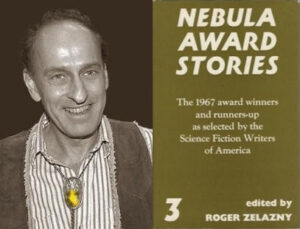
Zelazny’s Lord of Light (1967), nominated for a 1968 Nebula and winning the Hugo, would then entrench his distinct voice and approach to mythic world-building as a key component of mid-century SFF canon. That year, he would also support SFWA’s internal curation of canon, by editing our third-ever Nebula Award Stories anthology and providing thoughtful remarks on each tale.


Celebrating David Langford, SFWA’s Kate Wilhelm Solstice Award Recipient

FOR IMMEDIATE RELEASE:
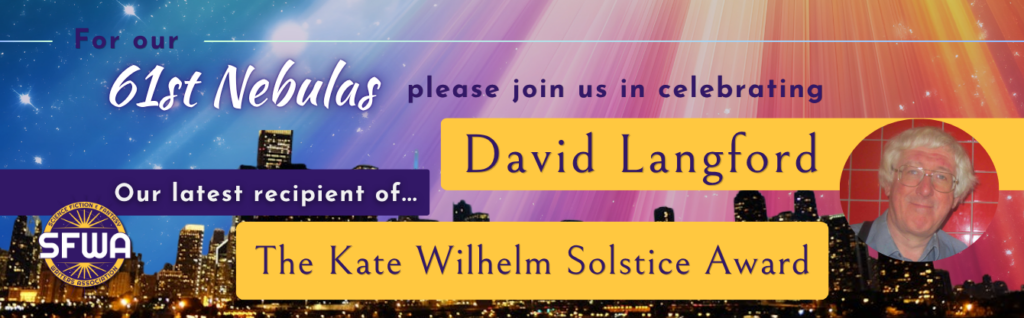
Celebrating David Langford, SFWA’s Kate Wilhelm Solstice Award Recipient for the 61st Annual Nebula Awards

San Francisco, CA – March 31, 2026

The Science Fiction and Fantasy Writers Association is pleased to announce that the Kate Wilhelm Solstice Award will be presented this year to David Langford at the 61st Annual SFWA Nebula Awards® ceremony on June 6, 2026.

The Kate Wilhelm Solstice Award is bestowed by SFWA upon a person who has made significant contributions to the community sustaining science fiction, fantasy, and related genres. The award was created in 2008, with Wilhelm named as one of the three original recipients, and it was renamed in her honor in 2016. Our latest recipient joins a storied list of winners, including Greg Bear, Ben Bova, Octavia Butler, Neil Clarke, Gardner Dozois, Joanna Russ, Stanley Schmidt, Nisi Shawl, Arley Sorg, and Sheila Williams, among many others.

How does one do justice to the work of a science-fiction creator whose wide-ranging pursuits, publications, and accolades include the long-standing and ongoing curation of The Encyclopedia of Science Fiction (SFE) itself?

As SFWA President Kate Ristau notes, “With his work on The Encyclopedia of Science Fiction, Langford has not only built, supported, and challenged the field of SFF; he has literally helped to define it. His decades of work have made science fiction a richer and more inclusive field. We are more than happy to present him with the Solstice Award in recognition of his career filled with positive, focused, and uplifting contributions.”

A Pillar of Service to Community

Those decades of service to our genre have taken many forms, all necessary for a thriving ecosystem in SFF publishing. Published authors of science fiction and fantasy are made possible by avid readers, equally avid commentators, fans dedicated to the cultivation of spaces to share and discuss great work, historians and archivists marking down events in genre of note, non-fiction writers offering supplement and story-seed to all our fantastic prose, editors sharpening one and the same, and publishers painstakingly building homes for all of the above.

Langford has been all of these, and more. He has handily merited his record-holding 29 Hugo wins out of 55 nominations, among a wealth of other honors in genre. Nor has his service to our ever-expanding community reached an end; along with SFE, Langford continues to sustain Ansible, a UK newszine covering SFF events and happenstance.

Langford’s dedication isn’t just known through titles, either, but also in his tonal range. Here is a commentator who would make readers laugh on one genre outing, then inspire serious reflection with the next. For decades, Langford’s editorial work took care where care was needed with the living history of our medium. His fan-community work brought joy where joy was needed in SFF, too.

“I am delighted to celebrate David Langford as the Science Fiction and Fantasy Writer’s Association 2026 Kate Wilhelm Solstice Award recipient,” says SFWA Executive Director Isis Asare. “His witty sense of humor and encylopedic knowledge of speculative literature has fostered an international discourse on science fiction. The measure of Langford’s impact cannot be overstated.”

The Celebration Continues

Please join SFWA in celebrating the achievements of David Langford, and all our other special guests and Nebula finalists, this June 3-7 at our 61st Annual Nebula Awards Conference in Chicago, Illinois. Conference prices for in-person tickets rise May 1, and Banquet tickets for the acclaimed Nebula Awards Ceremony on June 6 are in limited supply.

Be part of our ongoing history, in a genre that dedicated community-builders like David Langford have curated for us for so long, and so well.

Nebula Awards Finalists Announced

FOR IMMEDIATE RELEASE:
Introducing the Nebula Award Finalists for SFWA’s 61st Annual Awards

San Francisco, CA – March 15, 2026

The Science Fiction and Fantasy Writers Association (SFWA) is proud to announce its latest Nebula Award Finalists for works published in 2025, to be celebrated this year in Chicago at the organization’s 61st Annual Nebula Awards Conference.

Since 1965, SFWA has advocated for writers of science fiction, fantasy, and related genres. From that very first year, the Nebula Awards has been one of SFWA’s foundational pathways to improving the literary community and industry for SFF writers.

This year, SFWA celebrates two inaugural awards: one for Best Poem, and one for Best Comic. Like the Ray Bradbury Award for Outstanding Dramatic Presentation and Game Writing Award, these new awards celebrate the writers at the heart of productions that also involve editors, artists, publishers, producers, and a wealth of other team members who make the magic happen.

Voting on the Final Nebula Ballot begins at 7pm PDT on March 15, 2026, and runs until 11:59pm PDT on April 15, 2026. SFWA looks forward to celebrating this year’s Nebula Finalists this June, where winners of the final ballot will be announced on Saturday, June 6.

Thank you to everyone who votes, writes, reads, and otherwise contributes to the betterment of this genre in all its brilliant forms.

The Nebula Award for Best Novel

When We Were Real, by Daryl Gregory (Saga)
The Buffalo Hunter Hunter, by Stephen Graham Jones (Saga; Titan UK)
Katabasis, by R.F. Kuang (Harper Voyager US; Harper Voyager UK)
Death of the Author, by Nnedi Okorafor (Morrow; Gollancz)
The Incandescent, by Emily Tesh (Tor; Orbit UK)
Sour Cherry, by Natalia Theodoridou (Tin House; Wildfire)
Wearing the Lion, by John Wiswell (DAW; Arcadia)

The Nebula Award for Best Novella

Disgraced Return of the Kap’s Needle, by Renan Bernardo (Dark Matter INK)
The River Has Roots, by Amal El-Mohtar (Tordotcom; Arcadia)
The Death of Mountains, by Jordan Kurella (Lethe)
Automatic Noodle, by Annalee Newitz (Tordotcom)
But Not Too Bold, by Hache Pueyo (Tordotcom)
“Descent”, by Wole Talabi (Clarkesworld 5/25)

The Nebula Award for Best Novelette

“Our Echoes Drifting Through the Marsh”, by Marie Croke (Beneath Ceaseless Skies 1/9/25)
“Uncertain Sons”, by Thomas Ha (Uncertain Sons)
“We Begin Where Infinity Ends”, by Somto Ihezue (Clarkesworld 2/25)
The Name Ziya, by Wen-Yi Lee (Reactor)
“Never Eaten Vegetables”, by H.H. Pak (Clarkesworld 1/25)
“The Life and Times of Alavira the Great as Written by Titos Pavlou and Reviewed by Two Lifelong Friends”, by Eugenia Triantafyllou (Uncanny 3-4/25)

The Nebula Award for Best Short Story

“Through the Machine”, by P.A. Cornell (Lightspeed 5/25)
“Six People to Revise You”, by J.R. Dawson (Uncanny 1-2/25)
“In My Country”, by Thomas Ha (Clarkesworld 4/25)
“The Tawlish Island Songbook of the Dead”, by E.M. Linden (PodCastle 2/18/25)
“Because I Held His Name Like a Key”, by Aimee Ogden (Strange Horizons 6/16/25)
“Laser Eyes Ain’t Everything”, by Effie Seiberg (Diabolical Plots 5/25)

The Andre Norton Nebula Award for Middle Grade and Young Adult Fiction

The Tower, by David Anaxagoras (Recorded Books)
Gemini Rising, by Jonathan Brazee (Semper Fi Press)
Wishing Well, Wishing Well, by Jubilee Cho (Atthis Arts)
Sunrise on the Reaping, by Suzanne Collins (Scholastic)
Into the Wild Magic, by Michelle Knudsen (Candlewick)
Goblin Girl, by K.A. Mielke (self-published)

The Nebula Award for Best Game Writing

Spire, Surge, and Sea, by Stewart C. Baker (Choice of Games)
Clair Obscur: Expedition 33, by Guillaume Broche, & Jennifer Svedberg-Yen (Kepler Interactive), Developer: Sandfall Interactive, Sandfall S.A.S.
Hollow Knight: Silksong, by Ari Gibson & William Pellen (Team Cherry)*
Dispatch, by Ashley Jeffalone, Suzee Matson, Chris Rebbert, Chad Rhiness, & Pierre Shorette (AdHoc Studios)
Hades II, by Greg Kasavin
(Supergiant Games)
Blue Prince, by Tonda Ros (Raw Fury, Developer: Dogubomb)

The Ray Bradbury Nebula Award for Outstanding Dramatic Presentation

KPop Demon Hunters, by Danya Jimenez, Maggie Kang, & Hannah McMechan (Netflix)*
Sinners, by Ryan Coogler (Warner Bros Pictures)*
Severance: “Chikhai Bardo”, by Dan Erickson & Mark Friedman (Apple TV+)*
Pluribus: Season One, by Vince Gilligan (Apple TV+)*
Superman, by James Gunn (Warner Bros Pictures)*
Murderbot: Season One, by Paul Weitz and Chris Weitz (Apple TV+)*

The Nebula Award for Best Comic

Second Shift, by Kit Anderson (Avery Hill)
Carmilla Volume 3: The Eternal, by Amy Chu (Berger)
Helen of Wyndhorn, by Tom King (Dark Horse)
Fishflies, by Jeff Lemire (Image)
Mary Shelley’s School for Monsters: The Killing Stone, by Jessica Maison (Wicked Tree)
Strange Bedfellows, by Ariel Slamet Ries (HarperAlley)
The Flip Side, by Jason Walz (Rocky Pond)
The Stoneshore Register, by G. Willow Wilson (Berger)

The Nebula Award for Best Poem

“Though You Always Are”, by Linda D. Addison & Jamal Hodge (Everything Endless)
“They Said Robots Are”, by Casey Aimer (Penumbric 6/25)
“The World To Come”, by Jennifer Hudak (Strange Horizons 12/22/25)
“The Mourning Robot”, by Angela Liu (Uncanny 9-10/25)
“Care for Lightning”, by Mari Ness (Uncanny 1-2/25)
“To Be the Change”, by Nico Martinez Nocito (Strange Horizons 3/10/25)

*Provisional nomination; awaiting acceptance and response on LLM-use.

Tananarive Due Selected as Toastmaster for the 61st Annual Nebula Awards Conference  

GeneralFeaturedImages_14.png

San Francisco, CA  – February 24, 2026

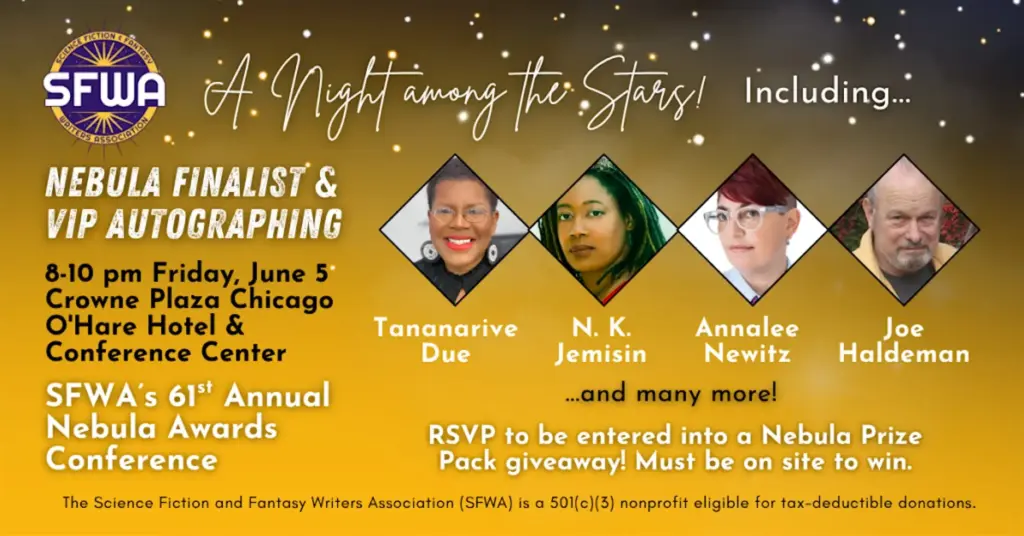
The Science Fiction and Fantasy Writers Association (SFWA)  is proud to announce that American Book Award, NAACP Image Award, and British Fantasy Award-winning author Tananarive Due will serve as Toastmaster for the 61st Annual Nebula Awards Conference happening in Chicago, IL from June 3-7. Previous Toastmasters include Erin RobertsSarah GaileyAydrea Walden, and Astronaut Dr. Kjell Lindgren.

“Due is an exceptional speaker – brilliantly insightful, delightfully funny – and deeply generous in her commitment to elevating the craft of speculative fiction writing across media,” said SFWA Executive Director Isis Asare. “She is the perfect toastmaster for the Nebula Awards Conference celebrating N. K. Jemisin as the recipient for the Damon Knight Memorial Grand Master Award and Gay Haldeman as the recipient for the Kevin O’Donnell, Jr. Service to SFWA Award.”

A rich tradition of storytelling

Due is the acclaimed author of The Reformatory (winner of a Los Angeles Times Book Prize, Chautauqua Prize, Bram Stoker Award, Shirley Jackson Award, World Fantasy Award, and a New York Times Notable Book), The Wishing Pool and Other StoriesGhost Summer: StoriesMy Soul to KeepThe Good House, and contributing author of Out There Screaming: An Anthology of New Black Horror.

A seasoned multimedia creator, Due and her husband/collaborator – Steven Barnes – recently co-directed their first short horror film, “The Keeper” (Samansa/Blackmaled), which will stream on Samansa in September. They also wrote “A Small Town” for Jordan Peele’s The Twilight Zone on Paramount Plus and two segments of Shudder’s anthology film Horror Noire. In addition, they co-wrote the Black Horror graphic novel The Keeper, illustrated by Marco Finnegan and published by Megascope. Due and Barnes co-host the podcast Lifewriting: Write for Your Life! Due also served as executive producer on Shudder’s groundbreaking documentary Horror Noire: A History of Black Horror.

“It’s such a thrill to be invited to be Toastmaster at the Nebulas, which has such a storied history, especially during a year honoring N. K. Jemisin and Gay Haldeman. Events like this remind us of the power of art to help create hope and change during difficult times,” Due said.

Gearing up to the Nebulas in Chicago

Tananarive Due and Steven Barnes will also participate in author signings, hybrid panels, and in-person craft workshops during the Nebula Awards Conference. Author signings will be open to the public and copies of Due’s work will be available to purchase onsite from local independent bookstore Call and Response. Hybrid programming will also be available to attendees of Horror Writers Association’s StokerCon as a result of a recent collaboration between HWA and SFWA.

“The Horror Writers Association is pleased to see more collaboration and advancement of partnerships between genre-organizations. We’re excited to offer this unique virtual experience to members of both SFWA and the HWA to encourage virtual participation for both the Nebulas and StokerCon,” stated Maxwell Gold, Executive Director of the Horror Writers Association.

Learn more about the 61st Nebula Awards Conference, running from June 3-7 in Chicago, IL by visiting SFWA.org. Nebula Award Finalists will be announced March 15. Secure early registration pricing before May 1st.

New Jay Kay Klein Photos Online including 1967 Nebulas; Need Caption Help

UPDATED 3/1/26.

To the science fiction community,

I’m Dr. Phoenix Alexander, the Klein Librarian for Science Fiction and Fantasy here at University of California, Riverside, where I steward the Eaton Collection: one of the world’s largest cataloged collections of science fiction, fantasy, horror, and related genre materials. I’m also a published author of over 20 short stories in venues such as F&SF, Lightspeed, Escape Pod, and The Dark, and serve on SFWA’s History Committee.

I joined UCR Library in 2022, but as you might know, we began digitization of the Jay Kay Klein photographs back in 2017, publishing just under 6,000 images onto a publicly accessible digital repository, Calisphere, as part of a mass digitization pilot initiative. During this pilot initiative, we solicited community feedback on the descriptions of the photos, utilizing a Google form and later a comment function on Calisphere itself. From Fall 2019 to Summer 2021, the UCR Library undertook a comprehensive review project, led by Andrew Lippert, Special Collections Processing Archivist, to update all of the titles and descriptions for the Klein photos on Calisphere, incorporating the voluminous and extraordinarily helpful community feedback received since the initial publication of the photos.

Over the last few years, we’ve continued to digitize the remaining 57,000 images from the Klein collection (an ongoing project that will take many more years to complete, as you can imagine!), but we’re delighted to announce the publication of the first of eleven boxes of photos, comprising almost 2,000 images of 47 conventions and events.

To share hundreds of photos more quickly with the community, we decided to implement a two-phase approach to our descriptions. Some photos from the new box will appear with basic information about the convention or event they belong to, with Klein’s original identifiers for his images as temporary titles. These will be updated later with more details about the people and topics depicted. Other photos will have descriptions already enhanced by myself and Andrew Lippert, both subject specialists (albeit not infallible ones!). We will continue describing and publishing the remainder of the photos, one box at a time, in chronological order.

Once again, we welcome feedback from the community to assist with identifications in the photos. We have compiled a web page with guidance on commenting practices to ensure that your time and labor is respected, and that your feedback will be most helpful to us as we continue to review, add, and amend the descriptions of these images. As science fiction fans and experts, we are of course familiar with the well-known figures of the genre that you’ll see in these collections—so if possible please avoid identifying figures such as Asimov, Heinlein, Pohl, and others of similar notoriety. Your feedback will be most valuable in identifying the lesser-known individuals in the photographs, in particular, fan attendees.


In the Jay Kay Klein photograph collection each individual photo is on its own webpage. Click the photo to open the page. The ‘Item Information’ section has a description containing identifications made on earlier passes. Are you able to add one?  We use Disqus to collect comments giving us identifications. There is a button to ‘JOIN THE DISCUSSION’. Click that button, and existing comments will be displayed with the newest identifications. You will be able to add your own.


We’re honored to be able to make these wonderful snapshots of the SF community publicly accessible in the years to come, and thank you in advance for your patience and generosity! If you have any questions or concerns, please don’t hesitate to reach out to me at phoenix.alexander@ucr.edu.

Many thanks,

Phoenix & the UCR team

For ease of reference, the new collections are as follows (you can search for them in the ‘Event’ box to the left of the landing page for the Klein photos, NOT the ‘Decade’ box):
1950s_1
1950s_2
1950s
1950
Hydracon, 1950
1950s_3
1951_1
1951_2
Unknown_1
Nycon 2, 1956
1960
1961
Midwestcon 13, 1962
ESFA, 1963
1963_1
1963_2
1963_3
ESFA, 1964
Midwestcon 15, 1964
Philcon, 1964
ESFA, 1965
1965_1
FistFa, 1965
1965_2
1965_3
Lunacon 8, 1965
Disclave 9, 1965
Midwestcon 16, 1965
Asheak, 1965
Boskone 1, 1965
Philcon, 1965
Boskone 2, 1966
Lunacon 9, 1966
Moskowitz gathering, 1966
Los Angeles and San Francisco Trip, 1966
Midwestcon 17, 1966
1967_1
Lunarians, 1967
IEEE International Convention, 1967
Open ESFA, 1967
Science Fiction Writers of America Awards, 1967
Pohl at Syracuse University, 1967
Lunacon 10, 1967
Jay Kay Klein (left), Frederik Pohl (right) at the 1966 Worldcon in Cleveland.

Announcing Our Latest Kevin O’Donnell, Jr. Service to SFWA Award Recipient, Gay Haldeman

The Science Fiction & Fantasy Writers Association (SFWA) is proud to announce that the latest Kevin O’Donnell, Jr. Service to SFWA Award will be presented to Gay Haldeman at the 61st SFWA Nebula Awards® for her outstanding work on behalf of the organization.

Gay Haldeman is a long-time SF fan, who began attending conventions in 1963. Born Mary Gay Potter, she met Joe at age 15 when he was 17, and together they built a life around science fiction. Gay helped found the Science Fiction League at the University of Iowa in 1975, and also the club convention DemiCon. Gay Haldeman was active in the Washington Science Fiction Association, serving as club secretary from 1966-1971. She shared NESFA’s Skylark Award with Joe in 1996 and won the Worldcon’s Big Heart award in 2011 in Reno.

A master of many disciplines, Gay earned a Master’s degree in Spanish Literature from the University of Maryland and another in Linguistics, from the University of Iowa. She taught for many years at MIT’s Writing Center.

Last year, when Brian Herbert accepted the Infinity Award on behalf of his late father, he reminded us that life partners often make the most famous work in our field possible–including Beverly Herbert, whose care and contributions made her husband Frank’s success possible.

Gay has been a proud steward of her husband Joe’s excellent career in genre for decades, and it is this curatorial care that she has also graciously gifted to the SFWA community through her volunteer work with us, most recently in the role of SFWA Ombudsman and more broadly as one of the most welcoming people this organization has been fortunate to count among its own.

“What a joy it has been to get to work with Gay over the years, and an honor to learn from her grace and expertise,” said Kate Ristau, SFWA President. “She is the literal embodiment of community; she has selflessly given her support to SFWA over the years while also challenging us to do better and to be better.”

“Gay was one of the first people to welcome me to SFWA, and her kindness to members, volunteers, staff, and the board is unparalleled,” Russell Davis, Operations Director said. “Her presence, her demeanor, and her unwavering commitment to making SFWA better for everyone in our community is second to none.”

SFWA is excited to honor Gay this year at our conference in Chicago, and we hope you’ll join us in honoring her service to the SFF community either in person or online during the event.

AMENDED RULES for the Nebula Awards (NEW!)

Earlier today, SFWA released a note from the Board on this year’s Nebula Award Rules with a link to the 2025 rules.

To be clear, SFWA does not support the use of LLM generative models in the production of creative work. 

The Nebula Award Rules linked did not reflect our current policy and deeply held beliefs and values, and they were amended to reflect that.

With further input, today, we made an important change to the Nebula Awards Rules in two board votes that we would like to share with you:

Previous Text:

“Works that are wholly written using generative large language model (LLM) tools are not eligible.”

New Text:

“Works that are written, either wholly or partially, by generative large language model (LLM) tools are not eligible.”

-and-

Previous Text:

“Works that used LLMs at any point during the writing process must disclose this upon acceptance of the nomination, and the nature of the technology’s use will be made clear to voters on the final ballot”

New Text:

“Works that used LLMs at any point during the writing process must disclose this upon acceptance of the nomination, and those works will be disqualified.”

We will update our posted rules in the coming days to reflect this change. 

We look forward to 2026 with optimism for the future of human-created work (that’s compensated, celebrated and supported)!

Keep on creating,

Kate Ristau 

SFWA President

On the Nebula Awards Rules for Our Current Nominations Cycle

Note from the SFWA Board of Directors

Nebula finalist nominations are flowing in. Thank you for your patience and encouragement as we set up a new system that is responsive, interactive, and secure. Members can visit their new Membership Portal today to read more about the Nebula process from our Nebula Awards Commissioner, Marcus Whitnell.

Since 1965, the Nebula Awards have been one way we honor the speculative fiction creators who bring us groundbreaking work that challenges expectations and opens up new possibilities. 

I have worked on the Nebula Awards since 2020, producing the ceremony in 2023 and 2024. Behind the scenes, the team tried to read through every piece, play every game, and watch every show that hit the final ballot. I may have spent a lot of time with Karlach in Baldur’s Gate

In all that time, the quality of the ballot continues to shine as bright as the brightest…Nebula. 

Sorry, I couldn’t help myself with the obvious metaphor.

But the rules we used in 1965 to prepare the ballot and support voting would not stand up to scrutiny in 2025. Over the years, the SFWA Board, staff, the Nebula Awards Commissioner (NAC), and the SFWA Awards Rules Committee (SARC) have worked to make sure the rules provide a secure, fair, legitimate, and legal framework for nomination and recognition.

This year’s review process raised several questions in genre categories, as well as around category minimums, appeals, and the use of LLM tools.

Vice President Anthony Eichenlaub detailed the rules revision process, beginning with the genre discussions, as follows:

“What ended up as a few bullet points in the official Nebula rules was actually a collaborative effort with the SARC, the NAC, and the comics and poetry committees. The words ‘poem of any length’ was the result of a long discussion on the nature of poetry and how our rules could possibly define the difference between poetry and very short prose fiction. We ultimately decided to trust the nominators and the voters. A lot of our philosophy comes down to that. Trust the voters.

These rule revisions saw several rounds of back and forth between committees, members, board, and staff, revealing more areas of concern. 

“While we were updating the rules for poetry and comics, we also addressed some minor pain points,” Anthony explained. “Our CFO, Jonathan Brazee, was the NAC before he was a Board member, and he had fantastic insight into the behind-the-scenes process. We changed how we do category minimums and added clarification on how rules can be appealed.”

These changes helped to refine the nominations process, with an emphasis on clarity and consistency.

One of the most complex and difficult decisions of 2025 was in rules additions around the use of artificial intelligence: a topic of many SFF stories, and now an active part of the world in which they are created.

Our 2023 statement on AI/ML points to the fact that “writing and publishing genre fiction is a business with important norms.”

At SFWA, we believe in our creatorsand we want the Nebula Awards to recognize work that is human-created and expansive.

We want to reinforce industry standards while also encouraging the industry to do better: from crediting authors to valuing their work, to promoting transparency and open dialogue among creators.

Our Complete Nebula Awards® Rules take this approach to heart. The rules state:

  • Works that are wholly written using generative large language model (LLM) tools are not eligible.
  • Works that used LLMs at any point during the writing process must disclose this upon acceptance of the nomination, and the nature of the technology’s use will be made clear to voters on the final ballot.

To repeat, works that are wholly written using generative large language model (LLM) tools are not eligible. The Nebula Awards honor writers and the work they create, not the LLMs they employ. 

When finalists are contacted, before they appear on the ballot, they will be asked to disclose any LLMs they used in the production of their work. The voters can then decide if they would like to vote for these works.

As of now, the industry standard overwhelmingly favors human-created work, from submissions guidelines to awards lists. As your SFWA President, I hope we continue to move in a direction that honors, supports, compensates, and celebrates the humans behind the great stories and poems we have the honor of reading, playing, and watching. 

I have no doubt our upcoming final ballot is going to present an incredible list of finalists. I personally can’t wait to read what you honor with your vote. 

Write on (and make you nominations.

Kate Ristau

SFWA President

Nebula Awards® Nominations Begin!

It’s Nebula Awards® voting season again!

As of December 1, 2025, our Nebula Awards Nomination Ballot is now open. In this year’s ballot, we are honored to celebrate our first-ever Nebula Awards in two new categories, along with our classic range of fiction. Full, Associate, and Senior member of SFWA, are eligible to submit a nomination ballot for the Nebula Awards.

This year SFWA members will be voting for top Nebula honors in the following fields:

  • Best Short Story
  • Best Novelette
  • Best Novella
  • Best Novel
  • Best Game Writing
  • Best Comic
  • Best Poem
  • The Ray Bradbury Nebula Award for Outstanding Dramatic Presentation
  • The Andre Norton Nebula Award for Middle Grade and Young Adult Fiction 

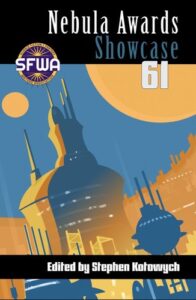
Many of these works will then be available in our next Nebula Awards Showcase, for sale right after the winners are announced in June, when we celebrate our latest bright stars in genre at the Nebulas in Chicago.


1 2 3 4 5 6 7 8 9 10 Last ›